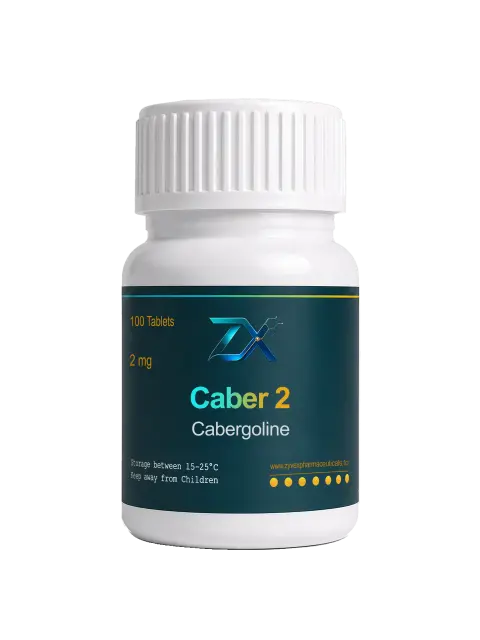
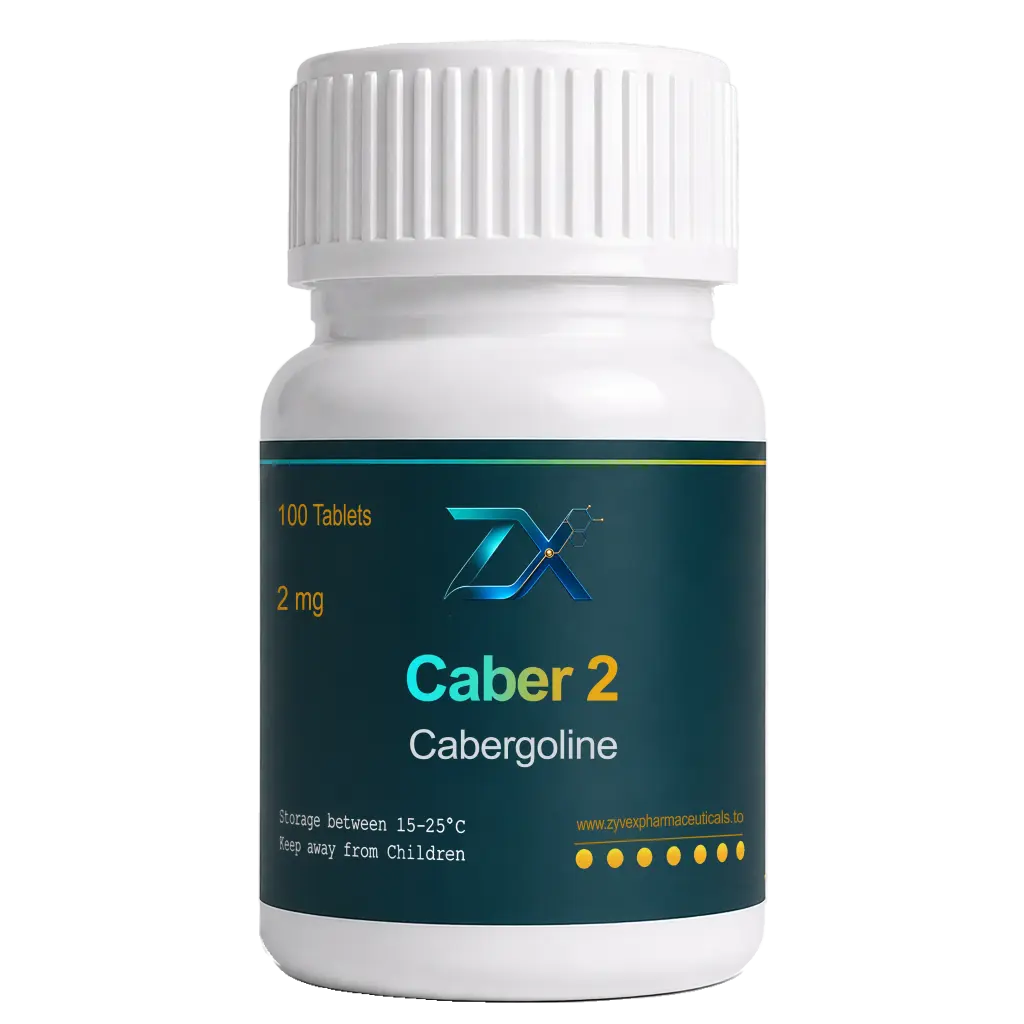
Product photograph of the current pack. Each physical unit carries the same blue-teal ZX label artwork, a batch code and a scratch-off verification panel.
Caber 2mg
Cabergoline
- Compound
- Cabergoline
- Category
- Erectile Dysfunction Drugs
- Brand
- Cabaser
- Manufacturer
- Zyvex Pharmaceuticals
- Presentation
- 100 tabs
- Strength
- 2 mg/tab
- Route
- Oral
- Storage
- 15–25 °C, protected from light, do not freeze
Batch analysis
Independent batch results for Caber 2mg are not yet published. They will be added here once testing is complete.
Product information
About Caber 2mg
2 mg per tablet · 100 tablets · Zyvex Pharmaceuticals
Caber 2 from Zyvex Pharmaceuticals contains cabergoline at 2 mg per tablet and comes in a pack of 100 tablets.
This prospect summarises composition, clinical considerations and handling. It supports professional review and does not replace an individual prescription or verified instructions for the exact preparation.
Basic Identification & Composition
Product Name & Active Ingredient
Caber 2 is the product name used by Zyvex Pharmaceuticals. The ingredient discussed in the following sections is cabergoline, classified as a dopamine d2 receptor agonist.
Qualitative & Quantitative Composition
| Property | Details |
|---|---|
| Product name | Caber 2 |
| Manufacturer | Zyvex Pharmaceuticals |
| Active ingredient | Cabergoline |
| Strength | 2 mg per tablet |
| Package | 100 tablets |
| Drug class | Dopamine D2 receptor agonist |
| Chemical formula | C26H37N5O2 |
| Dosage form and route | Tablet; oral |
Dosage Form
A solid tablet for oral administration. Each tablet provides a measured amount of active ingredient. Confirm suitability with a pharmacist before splitting or crushing; appearance and score lines alone do not establish accurate dose division.
Clinical Particulars
Caber 2 uses
Caber 2 from Zyvex Pharmaceuticals contains cabergoline. Cabergoline treats excessive prolactin, including prolactin elevation caused by pituitary adenomas. Lowering prolactin can help associated menstrual, fertility or sexual symptoms. A medical starting example is 0.25 mg twice weekly, with adjustments no more frequently than every four weeks according to response.
Some steroid users take cabergoline to address presumed prolactin-related breast or sexual symptoms. Such symptoms do not establish high prolactin, and this practice does not demonstrate an improvement in general wellbeing.
The 2 mg tablet contains eight times the example starting single dose. Published reports of accessory-drug use do not establish a reliable bodybuilding protocol. Prolactin testing, cardiac assessment and review for low blood pressure or compulsive behaviour are relevant to clinical treatment.
Dosage and Administration
Reference treatment commonly starts at 0.25 mg orally twice weekly, with gradual clinician-led adjustment. Caber 2 contains 2 mg per tablet, which is eight times that starting single dose. Do not take one whole tablet as a default dose or assume that division into eighths is accurate. The pharmacist should provide a formulation that can deliver the prescribed amount.
Contraindications
Do not use with uncontrolled hypertension, hypersensitivity to ergot derivatives, cardiac valve disease or a history of specified fibrotic disorders affecting the heart, lungs or retroperitoneum.
Warnings and Precautions
Cardiovascular assessment, including echocardiography, is needed before treatment, with follow-up as indicated. Cabergoline can cause valve damage, fibrosis, postural hypotension and compulsive behaviours. Report breathlessness, persistent chest pain, fainting or new gambling or spending urges.
Risks and Interactions
Drug & Food Interactions
Dopamine antagonists, including some antipsychotics and metoclopramide, can oppose the effect. Other blood-pressure-lowering medicines can increase dizziness or fainting. Review the full medication list before treatment.
Pregnancy and Lactation
Pregnancy planning and treatment during pregnancy require specialist review. Cabergoline suppresses prolactin and can reduce milk production; it should not be used as a routine method of suppressing postpartum lactation.
Side Effects and Adverse Reactions
Nausea, headache, dizziness and constipation are reported. More serious reactions include valvular or fibrotic disease, marked hypotension and impulse-control disorders.
Overdose Protocol
Excess cabergoline may cause nausea, vomiting, postural hypotension, confusion or hallucinations. Blood pressure and neurological symptoms require clinical assessment. For a suspected overdose, contact a poison-information service or urgent medical care and provide the product, amount, time and other substances taken. Collapse, seizures or breathing difficulty require emergency help. Do not induce vomiting or attempt an antidote at home. Clinical treatment depends on symptoms and the substances involved.
Scientific & Technical Data
Pharmacodynamics
Cabergoline stimulates dopamine D2 receptors on pituitary lactotroph cells, reducing prolactin secretion.
Pharmacokinetics
Cabergoline is absorbed after oral dosing and is extensively metabolised, mainly by hydrolysis. Its prolonged elimination supports intermittent rather than automatically daily administration. The clinical response and prolactin level guide treatment.
Storage and Handling
Cabergoline tablets are generally kept at controlled room temperature in a closed container. Keep tablets in their original, tightly closed container, protected from excess heat and moisture and out of the sight and reach of children. Follow the temperature limits and expiry date on the pack. Return expired or unwanted medicines through a pharmacy or medicine take-back programme; do not flush them.
Browse more